
 Food Editor
The infinite variety of foods in Australia reflects the diversity of its land and provides for a rich cuisine. In the South, dense pine forests and lush green pastures cover the land that is used to grow cattle and prime lamb, whilst its cold, clean southern waters provide delicious lobster and scallops. Grazing gives way then to the vineyards growing on the Terra Rosa soil of the Coonawarra, and cropping lands of the upper south east with their majestic red gums. The mighty River Murray turns red desert sand into a market garden and orchard as it wends its way from our northern border to the sea on the south coast at Goolwa. Along its length grow citrus, grapes, stone fruits, melons, tomatoes and a cornucopia of vegetables crops for local, interstate and international markets. World class wines grow in the slightly cooler climate of the Adelaide Hills, McLaren Vale and Barossa Valley. Sharing the lower slopes of the hills are apple and cherry orchards, berry farms and almond orchards, whilst the west coast has a wealth of seafood such as whiting, oysters and tuna.
The food culture brought to Australia by English immigrants
English immigrants first settled in South Australia in 1836, in ships such as “HMS Buffalo”, a replica of which is to be seen at Holdfast Bay. These folk established themselves on the Adelaide Plains, some gradually taking up agricultural land in the Adelaide Hills. In 1839 persecuted Lutheran immigrants from Prussia arrived, looking to establish their community in a free land, and moved to Hahndorf or the Barossa Valley. My own forebears arrived on the “Isabella Watson” in 1846. These people brought with them traditional English recipes, many of which appear in my own grandmother’s handwritten recipe book, such as Stewed Chops, Potato Dumplings and Jam Pudding. They were all simple recipes, not requiring complicated ingredients, and not costing much money, a style of cookery that reflected the modest means of the time. Among the English immigrants were sheep graziers providing prime lamb, others farmed beef cattle and still others became the butchers, bakers and candlestick makers of newly established towns. Many recipes, in hand written recipe books, brought to Australia by migrant women have been passed from one cook to another down the years. These recipes still hold their place in home cooking of today including Lamb Roast, Lamingtons, tasty Steak and Kidney Pies. They have been joined by dishes that have earned their special place in Australian history, such as the Pavlova, Soldier’s Cake and Anzac Biscuits, and of course for genteel afternoon teas, the Lamington and Pumpkin Scones.
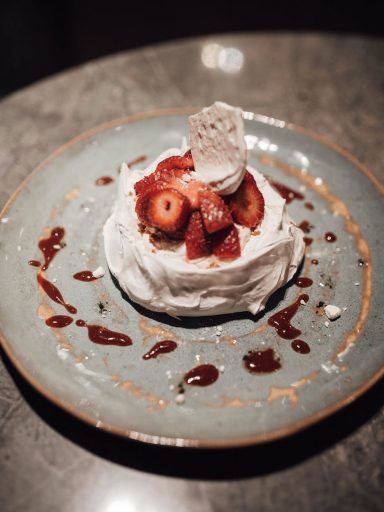
Damper: A damper is a traditional Australian bread, made without yeast, and commonly made on a campfire in a cast iron camp oven. Lamingtons: A chocolate coated cube of sponge cake, rolled in desiccated coconut; usually served with whipped cream and afternoon tea. It is said that Lamingtons were invented in the Queensland Government House kitchen as a creative use for stale sponge cake. I do not recommend that you use stale cake, but the mixture is easier to handle if the cake is not too fresh and crumbly. They are named after Lady Lamington, the wife of the Governor of Queensland from 1896 to 1901. Pavlova: A recipe developed by a chef in Western Australia, or so the story goes (or was it in New Zealand?) to celebrate the visit of the famous ballerina Anna Pavlova, is a confection of sugar and egg white meringue, covered with delicious whipped cream and seasonal fruits. (click to read full article) Anzac Biscuits: A rather hard but crisp biscuit of rolled oats and molassesSoldier’s Cake: A long keeping boiled fruit cake
At this stage in my story of Australian food, I am forced to acknowledge that although English immigrants brought their foods and recipes to a new land, there was already a wealth of cultural food in existence. I refer to the indigenous foods and style of eating that of course was the very first cuisine established in this country. It may have taken many decades for this to be acknowledged, but there is an awakening taking place both in Australia and internationally.
The oldest food culture – indigenous Australian food or native food
For centuries the indigenous people of this country have used the fruits and plants growing widely on the land. It may have taken a long time, but it is satisfying to realise that Indigenous foods are becoming more widely known and available, being grown very successfully by a group of visionary farmers in South Australia, and enabling the creation of dishes such as; Calamari seasoned with lemon myrtle, Lemon myrtle linguine tossed with local scallops and prawns, Native spinach fettuccine with Springs Smoked Salmon with creamy bush tomato and macadamia sauce, Kangaroo fillet crusted with Mountain Pepper, and served with a pepper berry dressing and fresh leaf salad. Damper is a perfect example of a food passed from one tradition to another. The aboriginal people have traditionally ground seeds to make a kind of flour, added water and baked a kind of Damper in the coals of their cooking fires. Damper became the means of outback stockmen having fresh bread, but using the more traditional flours, and using a camp oven for baking in the hot coals of the camp fire.
In Oz we have a little freshwater crustacean that lurks on the bottom of streams, lakes and in farm dams, they are called Yabbies, and have been enjoyed by indigenous Australians for centuries. An enterprising lady at Inman Valley, looking to diversify on a dairy farm during a downturn in the dairy industry, tried farming yabbies in her farm dams. She has established a successful and innovative business, buying and marketing yabbies. Now the rest of the world is waking up to their secret delights. Their delicate, sweet flavour and firm texture has won lavish praise from connoisseurs the world over. They are absolutely delicious, and can be used in Yabbie Chowder, Yabbie Pate, or Yabbie Stir Fry with Asian vegetables.
Lemon myrtle: fresh leaf, or ground dried leaf of the Lemon Myrtle tree
Mountain Pepper: ground leaf or berries of the mountain pepper tree
Native spinach: warrugul greens, a native spinach growing in coastal areas
Bush tomatoes: small tomato-like fruits, also called desert raising
Macadamia nuts: a nut, native of Australia, now grown in other places
Wattle seed: A small, oval, black variety of the Acacia seed. Wattle seed is used in
myriad foods including rice, soups, meat rubs and baked goods.
Innovation in Australian Cuisine
In response to Tourism, innovative chefs have worked very hard to produce a regional cuisine using the most wonderfully fresh food, which can be enjoyed without a damaging sting in the hip pocket, and can be washed down with an amazing variety of world class locally produced wines. The wine will most probably have been produced from the vineyards surrounding the town, the reds having mellowed in the autumn sun, and the whites exhibiting the crisp fruity style of the vale such as The Olive Grove Chardonnay. A typical menu at my favourite restaurant might read like this : Turkey liver and Mountain Pepper pate, grilled Kangaroo fillet with red wine and Muntrie glaze, sweet potato chips and fresh garden salad drizzled with a dressing made from local Olive Oil and Red Wine Vinegar, followed by Lemon Myrtle curd tart and Kangaroo Island clotted cream, with a glass of excellent mellow shiraz or a crisp fruity chardonnay.
Migration to Australia
The story of innovation in South Australian food would not be complete without mention of the tremendous contribution made by other cultures such as the German, Italian, Greek, Asian and South African immigrant communities, bringing both recipes and plant stock to their new home. Someone planted a few olive trees – probably an Italian or Greek immigrant longing to have the taste of home, and soon we had innocent little Australian bush birds eating the fruit, and pushing the seeds out the other end to plant them in other regions. Through the Adelaide Hills we have many self sown, or should I say bird sown, Olive trees from which some pressing plants produce what they label Ferral Olive Oil. It is a delicious oil, being a full flavoured and peppery golden drop.
German communities also had their own food producers such as traditional German bakers, German butchers with wonderful spicy metwurst, and pickle makers, finding the perfect ingredients here to continue the practice of their traditional crafts. What a treat it is to walk into one of these bakeries and inhale the yeasty aroma, to see the golden crusty loaves and delicious German cakes such as Bienenstich, a yeast cake, cream filled and topped with a sweet honey-nut layer.
Originally from Greece, Michael Angelakis said this about the early days in South Australia. “It was very tough,” says Michael. “A lot of families went to Thevenard on the West Coast because migrants had already established a fishing village there and you could speak your native language. This meant that the culture was kept alive, too, and the best way to learn another culture is through food.” These little seaside communities have become part of a large seafood industry. A walk through Adelaide’s fish market any day will bring you close to the salty smell of the sea, and amaze you with the incredible variety of oysters, abalone, lobster, prawns and blue fin tuna and other seafood. No need for the cook to use frozen seafood; we can have the plump, fresh oysters, still tasting of the deep southern waters to serve as Oysters Kilpatrick, fresh tuna steaks to be served as Grilled Tuna with Lemon Myrtle Sauce or Kingfish cutlets with a peppered crust served with Lime dressing.
Gone are the days when a lamb chop and three vegetables were standard fare in this community. Imaginative marketing presents the cook with many options such as marinated meats, fresh pasta and ready prepared fresh vegetables. There is certainly no excuse for boring or unattractive meals, with such a range of innovative recipes and fresh food products available in Australia today. Our chefs have inspired us to develop a great cuisine.
Note: You may also be interested to discover different types of Australian sandwiches: click for sandwich article
Australian Recipes:
• anzac biscuits
• apricot jam
• apricot jam with a twist
• apricot crisp
• australian cheesecake
• Bacon and Egg Pie
• bananas on the barbie
• BBQ meat patties (with kangaroo)
• carrot and cheese salad
• coconut jam tart
• cornbread with sweet potato
• damper
• golden syrup dumplings
• kangaroo fillets
• lamingtons
• lasagna with corn and spinach
• lasagna with sweet potato & pumpkin
• pasties
• pavlova
• pavlova – Pink Peppercorn Pavlovas with Strawberries, Vanilla Cream, and Basil Syrup from bon appetit desserts
• pepper crusted lamb with plum chutney
• potato dumplings
• potato salad Australian style
• potato salad with sausage skewers
• quince – baked
• quince and chilies salsa
• quince pickles
• quince marmalade
• Fruity-Veggie Cake
• Chocolate-Caramel Slice
• simnel cake
• soldier biscuits
• steak and kidney pie
• steamed jam pudding
• stewed lamb chops
• wattle seed pavlova
• yabbie (prawn) fettuccine
• zucchini and vegetable slice
Appreciating the hard work you put into your website and in depth information you present. It’s awesome to come across a blog every once in a while that isn’t the same old rehashed material. Wonderful read! I’ve saved your site and I’m including your RSS feeds to my Google account.
An impressive share, I simply given this onto a colleague who was doing a little evaluation on this. And he in actual fact bought me breakfast as a result of I discovered it for him.. smile. So let me reword that: Thnx for the deal with! But yeah Thnkx for spending the time to discuss this, I really feel strongly about it and love studying more on this topic. If attainable, as you change into expertise, would you mind updating your blog with extra details? It’s extremely useful for me. Huge thumb up for this weblog post!
I was reading some of your posts on this internet site and I conceive this site is rattling informative! Keep on putting up.
Incredible points. Great arguments. Keep up the great work.|
Hi it’s me, I am also visiting this web site daily, this web page is genuinely good and the viewers are genuinely sharing good thoughts.|
Thank you for the good writeup. It in fact was once a entertainment account it. Look complicated to far added agreeable from you! By the way, how could we keep in touch?|
I every time used to read paragraph in news papers but now as I am a user of web therefore from now I am using net for articles or reviews, thanks to web.|
I enjoy the efforts you have put in this, thank you for all the great posts.
Just about all of the things you assert is supprisingly accurate and it makes me ponder the reason why I had not looked at this in this light previously. This piece truly did turn the light on for me personally as far as this particular topic goes. Nevertheless there is actually one particular issue I am not too cozy with and whilst I make an effort to reconcile that with the actual core theme of your point, permit me observe just what the rest of your subscribers have to say.Nicely done.
I truly appreciate this blog article.Much thanks again. Really Cool.